Loading MadeScene content
 MadeScene
Private AI porn workspace
Create, edit, enhance and chat in one account
Loading MadeScene content
Image inspiration
The prompt is shortened to fit the generator. You can edit it before generating.
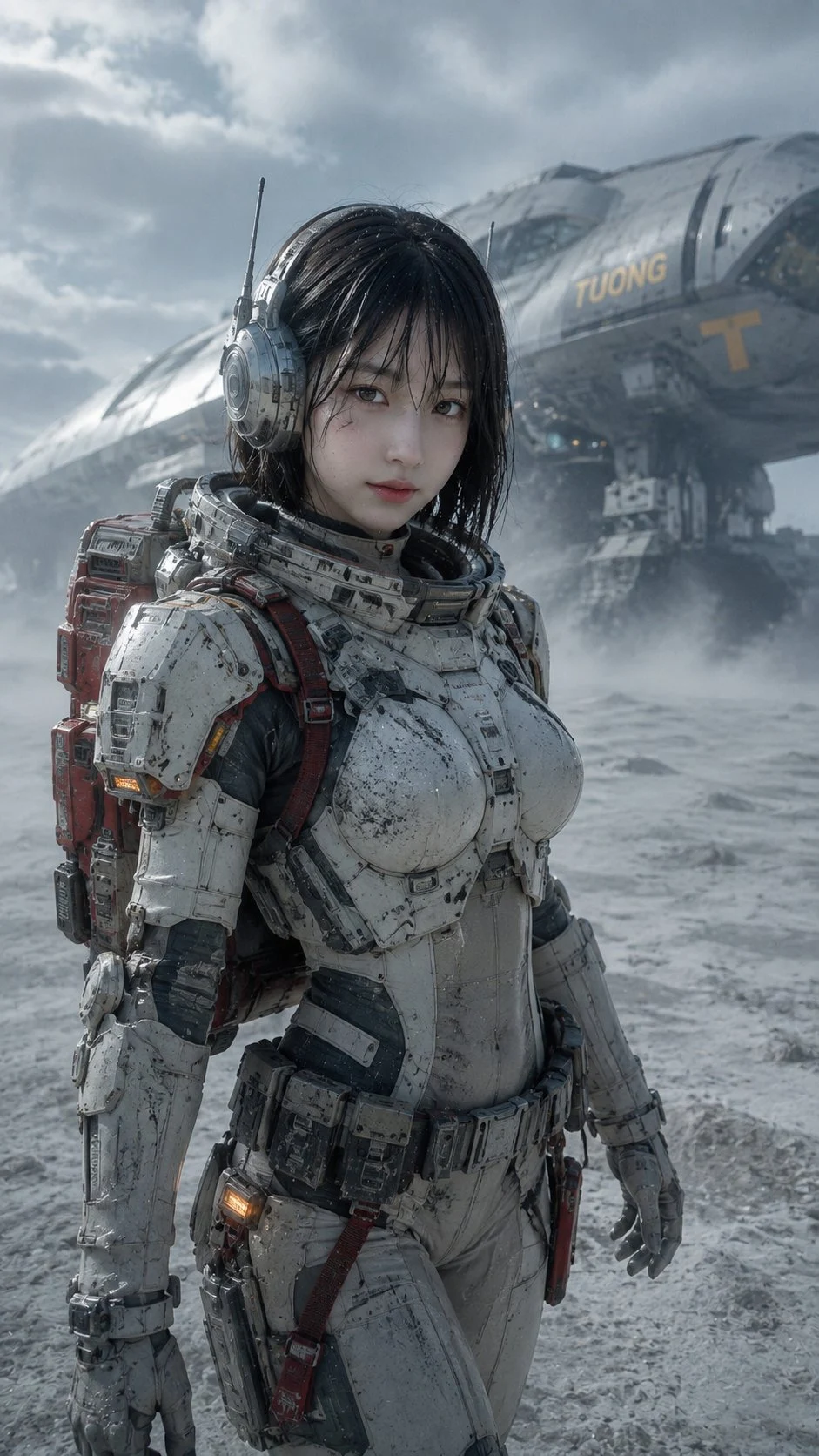
QUICK STORYLINE: A space explorer moves forward across a vast, freezing landscape after a long journey. Far behind, a gigantic spacecraft still rests on the ground, part of its hull obscured by mist and atmospheric haze. Strong winds continually sweep across the surface, carrying fine dust and small particles in moving bands close to the ground. Thick clouds cover the sky, with cold, soft, diffused light creating a lonely, harsh yet realistic feeling. The ship becomes a large-scale background focal point, emphasizing the distance and the character's journey. OUTFIT: A futuristic astronaut armor suit with complex mechanical construction, designed specifically for an extraterrestrial environment. The outfit consists of rigid ivory-white and silver-gray armor plates, with surfaces bearing realistic wear, small scratches, dirt, dark metal patches, and areas of subtle patina. Wear two silver earpieces with dusty sci-fi antennas. The upper body has a multilayered armor system, mechanical modules, joints, removable panels, technical fasteners, and numerous small industrial details. The shoulders are protected by large modular armor plates with circular emblems and technical markings. A large red life-support backpack sits on the back, integrating numerous mechanical components, panels, ventilation slots, and softly glowing orange indicator lights. Both arms are covered by successive armor modules, with mechanical joints, protective panels, and orange indicator lights. The gloves are multilayered mechanical gloves with clearly defined finger joints and complex industrial construction. The lower body continues with large ivory-white/gray armor plates and a broad industrial utility belt around the waist, with numerous storage boxes, fasteners, and functional modules. Preserve the red straps and small technical details. The entire outfit must precisely retain the reference's construction, materials, colors, proportions, wear marks, panels, lights, and accessories, without redesigning or simplifying it. BACKGROUND: Create a vast, cold, harsh extraterrestrial environment based on the BACKGROUND_REFERENCE description. A gigantic futuristic spacecraft sits far behind the character, partially obscured by mist and atmospheric haze. The ship must retain the reference design: a silver-gray metal hull, an aerodynamic form mixed with industrial elements, large doors and panels, dark windows, metal seams, dense mechanical detail underneath, an enormous landing-gear system, and numerous technical mechanisms. Preserve the ship's distinctive identifying details from the reference, including yellow “TUONG” lettering and a yellow “T” emblem on the hull, with proportions and placement appropriate to the viewpoint. Broad, flat, slightly reflective ground covered by a layer of fine dust. Strong winds sweep across the ground, creating bands of dust and small particles moving through the air. A cold layer of atmospheric haze reduces contrast in distant objects. The sky is covered with thick, cool-gray clouds, with no direct sunlight. Soft diffused light from the entire sky creates very subtle natural shadows. The atmosphere has clear depth: the foreground character is sharp, the middle ground has slightly reduced contrast, and the large background spacecraft is partially obscured by haze. Maintain realistic perspective and the enormous scale difference between ship and person, with the camera relatively low while still prioritizing the main character. The environment occupies approximately 30% of the frame, enough to convey the world's scale. POSE: Transfer the pose from POSE_REFERENCE precisely to the main character. The head turns slightly toward the camera, retaining the reference's head angle and gaze direction. The upper body rotates slightly in the direction corresponding to the reference pose. Both shoulders retain the correct height and rotation. The arms maintain positions corresponding to the reference, with elbows and wrists placed naturally according to the body's structure. Both hands retain the reference's relative positions, with naturally articulated, undistorted fingers. The hips, legs, and knees maintain the pose reference's weight-distribution logic, adjusted appropriately for movement across extraterrestrial ground. The body faces forward in a stepping motion. Weight is distributed evenly, creating the feeling that the character is genuinely walking in strong winds. Armor components and straps respond slightly to movement and wind without changing the pose's main silhouette. EXPRESSION: An extremely cool, composed expression. The eyes face directly forward according to the reference, focused and showing no fear despite the harsh environment. Slightly lowered eyelids convey control and coolness. The eyebrows remain steady, not raised. Lips slightly parted, no smile, no exaggerated expression. Facial muscles are relaxed yet defined, expressing absolute composure amid a windy, dusty extraterrestrial environment. Preserve the facial identity, facial structure, and identifying features of MAIN_CHARACTER_REFERENCE. Do not turn the face into someone else's, artificially beautify it, or change identity. IMAGE STYLE: Use the reference image strictly as a visual-quality, photographic-material, color-science, lighting, lens, atmosphere and image-rendering reference only. Do NOT copy, describe or reconstruct the subject matter, identity, anatomy, face, body, hairstyle, clothing, accessories, pose or narrative content from the reference. Extract only the photographic characteristics and reproduce the same visual language on a completely different scene. 01 — OVERALL IMAGE CHARACTER Ultra-realistic live-action photography with a highly immersive cinematic editorial look. The image should feel like an actual photograph captured inside a real physical environment rather than a digitally generated illustration. Strong photographic realism, natural optical behavior, realistic sensor response, physically believable light falloff, realistic material response, subtle imperfections, controlled highlight roll-off and authentic environmental depth. The overall image has a distinctive cool aqua / cyan dominant color atmosphere, contrasted against warmer red, cream, beige and neutral surfaces. The image should feel vivid and atmospheric without becoming excessively saturated or artificial. High visual information density with clearly separated foreground, middle ground and background planes. Maintain realistic photographic imperfections rather than creating an overly polished commercial CGI appearance. 02 — COLOR SCIENCE Primary environmental color language: dominant cyan-blue atmosphere turquoise architectural tones aqua highlights cool blue-green midtones slightly teal shadow contamination warm muted reds as secondary contrast soft cream / ivory highlights neutral gray-black deep shadows restrained warm beige accents occasional natural green vegetation tones subtle yellow-green environmental reflections The cyan component should be clearly visible throughout the image but remain photographic rather than neon. Use a teal-biased shadow/midtone relationship with comparatively warmer highlights and localized warm objects. Avoid generic orange-and-teal Hollywood grading. The palette should feel more like a naturally occurring cyan-tinted photographic environment with selective warm contrast. Saturation is moderately high but controlled. Cyan and turquoise colors are rich and recognizable while preserving texture inside bright surfaces. Reds should remain deep, slightly muted and natural rather than fluorescent. Whites should lean slightly cool under the environmental lighting, with occasional warm sunlight contamination. Blacks should remain deep and cinematic while retaining subtle shadow information. 03 — WHITE BALANCE Cool overall white balance with an approximate photographic feeling around 4800K–5400K, depending on local illumination. Do not make the entire image uniformly blue. Allow different light sources and reflected surfaces to produce natural color-temperature variation. Cool ambient illumination should dominate the environment while warmer daylight enters selected areas. Maintain realistic mixed-light behavior: cool cyan ambient light neutral daylight slightly warm reflected sunlight subtle green/cyan bounce from surrounding surfaces Color temperature variation should create depth rather than look like a digital color filter. 04 — EXPOSURE Bright but controlled exposure. Use a slightly luminous exposure characteristic with strong visibility in the environment while preserving darker tonal areas. Highlights should appear bright and clean without excessive clipping. Maintain detailed information in bright windows, reflective surfaces and illuminated environmental areas whenever physically possible. Shadows should be moderately deep but not crushed. Overall exposure should resemble a high-quality modern digital camera photograph captured in strong natural daylight with carefully controlled dynamic range. Avoid flat HDR. Avoid excessive local contrast. Avoid artificial glow around every bright object. 05 — DYNAMIC RANGE High dynamic range with realistic photographic compression. Preserve information across: bright exterior daylight illuminated surfaces midtone architecture darker interior regions reflective materials deep shadow areas Use smooth highlight roll-off rather than abrupt digital clipping. Bright regions should transition gradually from white into surrounding color. Shadow regions should retain subtle cyan/green/neutral information. The tonal curve should feel cinematic but still photographic. Moderate S-curve contrast: slightly lifted lower midtones strong but controlled midtone separation smooth highlight compression deep blacks without completely destroying shadow texture 06 — LIGHTING BEHAVIOR Natural daylight is the primary illumination system. Strong directional daylight enters from one or more openings and creates visible differences between illuminated and shaded areas. Use realistic sunlight diffusion rather than studio lighting. Light should bounce naturally from walls, floors, glass, furniture and surrounding surfaces. Environmental bounce lighting is important. Use subtle cyan-colored ambient bounce caused by the surrounding environment. Bright areas should contain soft secondary reflected illumination. Shadows should have physically plausible softness according to the distance and size of the light source. Avoid perfectly uniform artificial illumination. Avoid beauty-dish lighting. Avoid flat frontal flash. Avoid obvious studio three-point lighting. 07 — BACKLIGHT / WINDOW LIGHT CHARACTER Strong daylight from bright openings should create a subtle high-key backlit photographic atmosphere. Allow portions of the background to approach near-white exposure while maintaining recognizable structural information. Use natural lens response around bright areas. Slight atmospheric bloom may appear around extremely bright highlights, but it must remain subtle and optical. No excessive fantasy glow. No artificial light beams unless naturally justified by atmospheric conditions. 08 — LENS CHARACTER Photographic wide-angle lens behavior. Approximate focal-length feeling: 20–28mm full-frame equivalent, with a strong preference toward approximately 24mm. The lens should create a spacious environment while retaining realistic perspective. Noticeable but controlled wide-angle perspective. Objects closer to the lens may appear slightly enlarged compared with distant objects. Edges should exhibit mild natural perspective expansion. Do not use extreme fisheye distortion. Do not use exaggerated barrel distortion. Use subtle real-world wide-angle optical geometry. 09 — CAMERA POSITION / PERSPECTIVE CHARACTER The photographic perspective has a distinctly low camera placement, creating a strong upward environmental perspective. Camera remains physically close to the ground-level visual plane while pointing upward. Vertical architectural lines should remain mostly believable, with mild wide-angle convergence rather than extreme distortion. The composition should feel immersive, as if the camera physically occupies the environment. Maintain a strong sense of camera proximity. Avoid floating-camera appearance. Avoid impossible perspective. 10 — DEPTH OF FIELD Moderately shallow photographic depth of field. Primary visual planes should remain relatively sharp while distant environmental details gradually soften. Use realistic optical depth rather than artificial software blur. Background blur should be smooth and lens-dependent. No excessive bokeh. No circular CGI blur. No cutout-style subject separation. Environmental details should remain sufficiently recognizable to preserve the photographic storytelling quality. 11 — FOCUS CHARACTER Very precise optical focus with realistic micro-contrast. Fine textures should remain visible: wall texture glass foliage reflective surfaces wood metal ceramic fabric-like environmental materials skin-like organic textures if naturally present in the new scene Focus transition should be gradual and optical. No oversharpened AI edges. No halos around high-contrast boundaries. No fake clarity artifacts. 12 — MICRO-CONTRAST High but controlled micro-contrast. Fine details should have strong local separation without producing crunchy digital sharpening. Use realistic edge definition. Small environmental textures should remain visible when naturally within the focal plane. Avoid excessive HDR micro-detail. Avoid hyper-processed clarity. The image should retain the subtle softness of a real camera lens while simultaneously appearing highly detailed. 13 — SHARPNESS High-resolution photographic sharpness. Extremely clean central-detail rendering with naturally decreasing sharpness toward optical extremes. Edges should remain realistic rather than artificially outlined. No cartoon contouring. No AI-generated plastic edges. No excessive sharpening. No ringing. No overshoot around high-contrast objects. Fine detail should originate from realistic optical capture rather than digital enhancement. 14 — OPTICAL IMPERFECTIONS Include extremely subtle real-lens characteristics: mild chromatic aberration near extreme frame edges tiny highlight blooming subtle lens softness toward corners restrained vignetting mild optical distortion realistic specular response tiny exposure variation across complex surfaces These imperfections must remain subtle. The final image should still look professionally photographed. 15 — LENS FLARE Very restrained natural lens flare may appear around extremely bright daylight sources. Use small optical flare artifacts only when physically justified. Possible characteristics: faint translucent flare subtle veiling glare tiny highlight ghosts mild cyan/white flare contamination Avoid dramatic cinematic flare streaks. Avoid oversized anamorphic flares. Avoid obvious artificial light effects. 16 — ATMOSPHERIC DEPTH Clear but slightly humid atmospheric behavior. The air should have enough optical depth to create realistic separation between foreground and distant background. Use subtle aerial perspective. Distant areas may lose a small amount of contrast and saturation. Do not create heavy fog. Do not create mist unless naturally present. The atmosphere should feel clean, bright and slightly luminous. 17 — MATERIAL RESPONSE All physical surfaces should exhibit realistic PBR-like photographic response. Metal should show controlled specular reflections. Glass should contain realistic transparency, reflections and environmental highlights. Ceramic surfaces should show subtle diffuse-to-specular transitions. Painted walls should have soft diffuse reflection with small surface irregularities. Wood should contain directional grain and natural tonal variation. Plants and organic materials should display irregular micro-texture rather than smooth synthetic surfaces. Reflective materials should reflect the surrounding cyan environment naturally. No excessive mirror-like reflections unless the physical material requires them. 18 — SHADOW CHARACTER Soft-to-medium natural daylight shadows. Shadows should contain color information rather than becoming pure black. Cool cyan/blue ambient fill should subtly illuminate shadow regions. Contact shadows should be present where objects physically meet surfaces. Avoid floating objects. Avoid completely black artificial shadows. Shadow edges should vary according to light-source size and distance. 19 — HIGHLIGHT CHARACTER Highlights should be luminous but controlled. Use smooth digital-sensor highlight roll-off. Bright whites should retain subtle tonal gradients. Specular highlights should remain physically localized. Avoid excessive bloom. Avoid clipping large areas unnecessarily. Bright windows and reflective materials can approach white while retaining subtle cyan or warm transitions near their edges. 20 — TEXTURE / GRAIN Very clean high-resolution digital photography with an extremely subtle natural sensor texture. No obvious film grain overlay. No heavy cinematic grain. No artificial noise. If grain exists, it should be extremely fine and almost imperceptible, similar to a high-quality modern full-frame digital camera at low-to-moderate ISO. Maintain natural texture in every surface. Avoid plastic smoothing. Avoid waxy surfaces. Avoid AI beauty-filter texture. 21 — DIGITAL SENSOR CHARACTER Modern full-frame digital camera aesthetic. High dynamic range. Excellent shadow recovery. Clean color separation. Natural skin/material tonal transitions. Strong but realistic low-light shadow information. No smartphone computational-photography look. No excessive HDR stacking. No oversaturated computational colors. No aggressive noise reduction. No artificial sharpening. No makeup face No light in face 22 — IMAGE CONTRAST Moderate cinematic contrast. Deep enough blacks to create dimensionality. Midtones remain luminous. Highlights remain soft. Use local contrast selectively. The image should feel punchy without becoming harsh. Avoid crushed blacks. Avoid gray, washed-out blacks. Avoid excessive clarity. 23 — SATURATION Medium-high overall saturation with selective color emphasis. Cyan and turquoise should be the strongest environmental color family. Warm red tones should provide secondary visual contrast. Green should remain natural and slightly subdued. Whites should stay clean. Skin-like neutral colors in any newly generated scene must remain naturally balanced rather than inheriting excessive cyan contamination. Do not apply a universal color filter over the entire image. 24 — COLOR SEPARATION Maintain strong separation between: cyan environment warm red accents neutral whites dark charcoal/black areas natural greens warm beige elements Colors should remain individually identifiable. Avoid color bleeding. Avoid excessive chroma noise. Avoid neon oversaturation. 25 — COMPOSITIONAL OPTICS The image should have a strong sense of physical space. Foreground elements may partially enter the frame naturally. Environmental objects close to the lens may exhibit mild wide-angle enlargement. Background architecture should create depth through perspective. Use layered visual planes: foreground → primary visual plane → middle ground → distant background Maintain a natural documentary/editorial photographic feeling rather than a perfectly symmetrical commercial composition. 26 — IMAGE EDGE BEHAVIOR Central frame remains the sharpest and most optically controlled region. Peripheral regions may exhibit: slight softness mild perspective expansion subtle chromatic aberration tiny vignetting reduced micro-contrast Do not overdo these effects. 27 — VIGNETTE Extremely subtle optical vignetting. Corners may be slightly darker than the center. Vignetting should look like natural lens behavior rather than an applied post-processing effect. No heavy black vignette. 28 — POST-PROCESSING CHARACTER Minimal professional color grading. Prioritize realistic camera capture first, grading second. Use subtle: exposure balancing highlight compression shadow recovery color separation white-balance refinement micro-contrast enhancement restrained saturation adjustment Avoid obvious filters. Avoid Instagram-style presets. Avoid excessive teal-and-orange grading. Avoid excessive cinematic LUT appearance. 29 — PHOTOGRAPHIC REALISM Absolute priority: real camera photograph appearance. The final result must contain: physically believable illumination realistic reflections realistic shadows natural perspective optical depth authentic surface texture believable color response subtle lens imperfections realistic dynamic range natural exposure transitions No CGI appearance. No 3D-render appearance. No illustration appearance. No anime appearance. No painterly appearance. No plastic AI texture. No synthetic smoothness. No excessive beauty retouching. 30 — FINAL IMAGE FEEL Bright, cool, immersive, slightly surreal yet physically believable photographic atmosphere. The dominant impression should be: clean cyan daylight + strong wide-angle perspective + low camera viewpoint + luminous backlight + rich environmental color + high dynamic range + realistic optical imperfections + crisp micro-detail + soft highlight roll-off + cinematic photographic depth. The image should look like a carefully captured frame from a high-end modern full-frame camera, combining documentary realism with cinematic editorial color science. QUALITY TARGET: ultra-photorealistic, high-resolution, full-frame digital photography, natural optical rendering, physically plausible light, realistic color science, high dynamic range, controlled highlights, detailed shadows, authentic material texture, subtle lens imperfections, cinematic depth, clean atmospheric separation, realistic wide-angle perspective. IMPORTANT RESTRICTION: Use this prompt exclusively as a technical image-look reference. Do not reproduce any specific person, face, body, clothing, accessories, pose, identity, animal, object arrangement, location identity or narrative from the reference image. Only reproduce its photographic color, lighting, optical, material, texture, atmosphere, exposure, dynamic-range and rendering characteristics.@Generate image An extremely clear, sharp, highly detailed image that still feels like a real smartphone photograph. Neutral white balance, cold atmospheric environment, clean exposure, realistic material response, realistic atmospheric haze, subtle HDR. Saturation +15/100, while the overall palette remains cool and natural because of the cloudy environment. Do not shift to yellow or apply overly strong cinematic color grading. The character's skin is slightly tanned, not dark, and lightly dust-covered, visually approaching an albino-white shade while still showing real human skin texture, pores, and natural skin microstructure; do not turn it into plastic skin or artificially glowing white. Do not make the facial skin glow. Maintain a natural, balanced, full figure according to MAIN_CHARACTER_REFERENCE; a full, healthy, natural bust, without making the character look thin or lacking vitality. Do not distort anatomy. Close camera framing from approximately mid-thigh upward, with the main character occupying approximately 70% of the frame area and the environment approximately 30%. Absolutely do not use an excessively wide angle that makes the character small. Still retain enough background to recognize the gigantic spacecraft and the environment's scale. Vertical 9:16 composition. Close character-focused framing from approximately mid-thigh upward. Character approximately 70% of frame. Environment approximately 30% of frame. Natural smartphone perspective. Realistic phone-camera optics. Clean neutral white balance. Bright but naturally diffused exposure. Enhanced crispness and fine detail. Natural skin texture. Authentic human proportions. Realistic armor materials. Realistic metallic reflections. Realistic dust particles. Realistic wind interaction. Natural environmental depth. Subtle phone-camera HDR. No artificial beauty filter. No plastic skin. No CGI appearance. No illustration. No fantasy rendering. No artificial 3D look. No anime. No cartoon. No 2D. No excessive cinematic color grading. No yellow cast. No over-stylization. No distorted anatomy. No duplicated limbs. No merged mechanical parts. No floating objects. The final image must look like a genuine high-resolution real-life photograph captured with a modern iPhone during an extraordinary but physically believable moment of futuristic exploration. TEXT IN THE IMAGE: Include the exact text: “TUONG” The text must appear naturally and subtly somewhere within the environment, preferably on a small technical label, equipment panel, ground-side marker, distant mission sign, compact spacecraft-related object, or another physically plausible environmental surface. The text must be small, correctly aligned with the surface perspective, naturally illuminated, and partially integrated into the scene. It must not cover the main character, must not become the visual focus, must not appear as a watermark, and must not float unnaturally in the air. Maintain realistic perspective, realistic surface texture, realistic lighting and realistic shadows around the text. @Generate image
CỐT TRUYỆN NHANH: Một nhà thám hiểm không gian tiến về phía trước trên một vùng đất rộng và lạnh giá sau hành trình dài. Ở rất xa phía sau, một tàu vũ trụ khổng lồ vẫn đứng trên mặt đất, một phần thân tàu bị che khuất bởi màn sương và lớp haze khí quyển. Gió mạnh liên tục quét qua bề mặt, cuốn bụi mịn và các hạt nhỏ thành những dải chuyển động sát mặt đất. Bầu trời phủ đầy mây dày, ánh sáng khuếch tán lạnh và mềm, tạo cảm giác cô độc, khắc nghiệt nhưng chân thực. Chiếc tàu trở thành điểm nhấn quy mô lớn ở hậu cảnh, nhấn mạnh khoảng cách và hành trình của nhân vật. OUTFIT: một bộ giáp phi hành gia tương lai có cấu trúc cơ khí phức tạp, thiết kế chuyên dụng cho môi trường ngoài hành tinh. Bộ trang phục gồm các mảng giáp cứng màu trắng ngà và xám bạc với bề mặt phủ dấu hiệu hao mòn thực tế, các vết xước nhỏ, bụi bẩn, mảng kim loại sẫm màu và những vùng patina nhẹ.đeo hai tai nghe màu bạc có ăng ten sci-fi phủ bụi Phần thân trên có hệ thống giáp nhiều lớp, các module cơ khí, khớp nối, panel tháo lắp, khóa kỹ thuật và nhiều chi tiết công nghiệp nhỏ. Vai được bảo vệ bằng các mảng giáp lớn dạng module, có biểu tượng tròn và các ký hiệu kỹ thuật. Khu vực lưng mang một hệ thống backpack life-support lớn màu đỏ, tích hợp nhiều bộ phận cơ khí, panel, khe thông gió và các đèn tín hiệu màu cam phát sáng nhẹ. Hai cánh tay được bao phủ bởi các module giáp nối tiếp nhau, với khớp cơ khí, panel bảo vệ và các đèn tín hiệu màu cam. Găng tay là loại găng cơ khí nhiều lớp với các khớp ngón tay rõ ràng và cấu trúc công nghiệp phức tạp. Phần thân dưới tiếp tục với các mảng giáp lớn màu trắng ngà/xám, đai utility công nghiệp rộng quanh eo với nhiều hộp chứa, khóa và module chức năng. Các dải dây màu đỏ và chi tiết kỹ thuật nhỏ được giữ nguyên. Toàn bộ outfit phải giữ chính xác cấu trúc, chất liệu, màu sắc, tỷ lệ, vết hao mòn, panel, đèn và phụ kiện của reference, không thiết kế lại hoặc đơn giản hóa. NỀN: Tạo một môi trường ngoài hành tinh rộng lớn, lạnh và khắc nghiệt dựa trên mô tả BACKGROUND_REFERENCE. Một tàu vũ trụ tương lai khổng lồ nằm rất xa phía sau nhân vật, partially obscured by mist and atmospheric haze. Tàu phải giữ thiết kế từ reference: thân tàu kim loại màu xám bạc, hình dáng khí động học pha công nghiệp, hệ thống cửa và panel lớn, cửa sổ tối, các đường ghép kim loại, chi tiết cơ khí dày đặc ở phần dưới, hệ thống chân đáp khổng lồ và nhiều cơ cấu kỹ thuật. Giữ nguyên các chi tiết nhận diện nổi bật của tàu trong reference, bao gồm ký hiệu chữ “TUONG” màu vàng và biểu tượng “T” màu vàng trên thân tàu, với tỷ lệ và vị trí hợp lý theo góc nhìn. Mặt đất rộng, phẳng và hơi phản xạ, phủ một lớp bụi mịn. Gió mạnh thổi ngang mặt đất tạo các dải bụi và hạt nhỏ chuyển động trong không khí. Một lớp atmospheric haze lạnh làm giảm độ tương phản của những vật thể ở xa. Bầu trời phủ mây dày màu xám lạnh, không có ánh nắng trực tiếp. Ánh sáng khuếch tán mềm từ toàn bộ bầu trời, tạo bóng tự nhiên rất nhẹ. Không khí có chiều sâu rõ ràng: nhân vật ở tiền cảnh sắc nét, vùng trung cảnh hơi giảm tương phản, tàu vũ trụ ở hậu cảnh lớn nhưng bị haze che một phần. Giữ phối cảnh chân thực, tỷ lệ khổng lồ giữa tàu và con người, camera ở vị trí tương đối thấp nhưng vẫn ưu tiên nhân vật chính. Môi trường chiếm khoảng 30% khung hình, đủ để truyền tải quy mô của thế giới. TƯ THẾ: Chuyển chính xác tư thế từ POSE_REFERENCE sang nhân vật chính. Đầu hướng hơi quay về phía camera, giữ góc đầu và hướng ánh mắt theo reference. Thân trên hơi xoay theo hướng tương ứng với tư thế tham chiếu. Hai vai giữ đúng độ cao và góc xoay. Cánh tay duy trì vị trí tương ứng với reference, khuỷu tay và cổ tay được đặt tự nhiên theo cấu trúc cơ thể. Hai bàn tay giữ đúng vị trí tương đối của reference, với các ngón tay có khớp nối tự nhiên và không bị biến dạng. Phần hông, chân và đầu gối duy trì cùng logic phân bổ trọng lượng của pose reference, nhưng được điều chỉnh hợp lý để phù hợp với việc di chuyển trên mặt đất ngoài hành tinh. Cơ thể hướng về phía trước theo chuyển động đang tiến bước. Trọng lượng được phân bổ cân bằng, tạo cảm giác nhân vật thực sự đang bước đi trong gió mạnh. Các bộ phận giáp và dây đeo phản ứng nhẹ với chuyển động và sức gió, nhưng không làm thay đổi silhouette chính của tư thế. BIỂU CẢM: Biểu cảm cực kỳ lạnh lùng và điềm tĩnh. Ánh mắt hướng trực diện theo reference, tập trung và không biểu lộ sự hoảng sợ dù môi trường khắc nghiệt. Mi mắt hơi hạ, tạo cảm giác kiểm soát và lạnh. Lông mày giữ trạng thái ổn định, không nhướng lên. Môi hé nhẹ, không cười, không tạo biểu cảm quá mức. Cơ mặt thư giãn nhưng sắc nét, thể hiện sự bình tĩnh tuyệt đối giữa một môi trường ngoài hành tinh đầy gió bụi. Giữ nguyên facial identity, cấu trúc khuôn mặt và các đặc điểm nhận diện của MAIN_CHARACTER_REFERENCE. Không biến đổi khuôn mặt thành một gương mặt khác, không làm đẹp nhân tạo, không thay đổi identity. PHONG CÁCH HÌNH ẢNH: Use the reference image strictly as a visual-quality, photographic-material, color-science, lighting, lens, atmosphere and image-rendering reference only. Do NOT copy, describe or reconstruct the subject matter, identity, anatomy, face, body, hairstyle, clothing, accessories, pose or narrative content from the reference. Extract only the photographic characteristics and reproduce the same visual language on a completely different scene. 01 — OVERALL IMAGE CHARACTER Ultra-realistic live-action photography with a highly immersive cinematic editorial look. The image should feel like an actual photograph captured inside a real physical environment rather than a digitally generated illustration. Strong photographic realism, natural optical behavior, realistic sensor response, physically believable light falloff, realistic material response, subtle imperfections, controlled highlight roll-off and authentic environmental depth. The overall image has a distinctive cool aqua / cyan dominant color atmosphere, contrasted against warmer red, cream, beige and neutral surfaces. The image should feel vivid and atmospheric without becoming excessively saturated or artificial. High visual information density with clearly separated foreground, middle ground and background planes. Maintain realistic photographic imperfections rather than creating an overly polished commercial CGI appearance. 02 — COLOR SCIENCE Primary environmental color language: dominant cyan-blue atmosphere turquoise architectural tones aqua highlights cool blue-green midtones slightly teal shadow contamination warm muted reds as secondary contrast soft cream / ivory highlights neutral gray-black deep shadows restrained warm beige accents occasional natural green vegetation tones subtle yellow-green environmental reflections The cyan component should be clearly visible throughout the image but remain photographic rather than neon. Use a teal-biased shadow/midtone relationship with comparatively warmer highlights and localized warm objects. Avoid generic orange-and-teal Hollywood grading. The palette should feel more like a naturally occurring cyan-tinted photographic environment with selective warm contrast. Saturation is moderately high but controlled. Cyan and turquoise colors are rich and recognizable while preserving texture inside bright surfaces. Reds should remain deep, slightly muted and natural rather than fluorescent. Whites should lean slightly cool under the environmental lighting, with occasional warm sunlight contamination. Blacks should remain deep and cinematic while retaining subtle shadow information. 03 — WHITE BALANCE Cool overall white balance with an approximate photographic feeling around 4800K–5400K, depending on local illumination. Do not make the entire image uniformly blue. Allow different light sources and reflected surfaces to produce natural color-temperature variation. Cool ambient illumination should dominate the environment while warmer daylight enters selected areas. Maintain realistic mixed-light behavior: cool cyan ambient light neutral daylight slightly warm reflected sunlight subtle green/cyan bounce from surrounding surfaces Color temperature variation should create depth rather than look like a digital color filter. 04 — EXPOSURE Bright but controlled exposure. Use a slightly luminous exposure characteristic with strong visibility in the environment while preserving darker tonal areas. Highlights should appear bright and clean without excessive clipping. Maintain detailed information in bright windows, reflective surfaces and illuminated environmental areas whenever physically possible. Shadows should be moderately deep but not crushed. Overall exposure should resemble a high-quality modern digital camera photograph captured in strong natural daylight with carefully controlled dynamic range. Avoid flat HDR. Avoid excessive local contrast. Avoid artificial glow around every bright object. 05 — DYNAMIC RANGE High dynamic range with realistic photographic compression. Preserve information across: bright exterior daylight illuminated surfaces midtone architecture darker interior regions reflective materials deep shadow areas Use smooth highlight roll-off rather than abrupt digital clipping. Bright regions should transition gradually from white into surrounding color. Shadow regions should retain subtle cyan/green/neutral information. The tonal curve should feel cinematic but still photographic. Moderate S-curve contrast: slightly lifted lower midtones strong but controlled midtone separation smooth highlight compression deep blacks without completely destroying shadow texture 06 — LIGHTING BEHAVIOR Natural daylight is the primary illumination system. Strong directional daylight enters from one or more openings and creates visible differences between illuminated and shaded areas. Use realistic sunlight diffusion rather than studio lighting. Light should bounce naturally from walls, floors, glass, furniture and surrounding surfaces. Environmental bounce lighting is important. Use subtle cyan-colored ambient bounce caused by the surrounding environment. Bright areas should contain soft secondary reflected illumination. Shadows should have physically plausible softness according to the distance and size of the light source. Avoid perfectly uniform artificial illumination. Avoid beauty-dish lighting. Avoid flat frontal flash. Avoid obvious studio three-point lighting. 07 — BACKLIGHT / WINDOW LIGHT CHARACTER Strong daylight from bright openings should create a subtle high-key backlit photographic atmosphere. Allow portions of the background to approach near-white exposure while maintaining recognizable structural information. Use natural lens response around bright areas. Slight atmospheric bloom may appear around extremely bright highlights, but it must remain subtle and optical. No excessive fantasy glow. No artificial light beams unless naturally justified by atmospheric conditions. 08 — LENS CHARACTER Photographic wide-angle lens behavior. Approximate focal-length feeling: 20–28mm full-frame equivalent, with a strong preference toward approximately 24mm. The lens should create a spacious environment while retaining realistic perspective. Noticeable but controlled wide-angle perspective. Objects closer to the lens may appear slightly enlarged compared with distant objects. Edges should exhibit mild natural perspective expansion. Do not use extreme fisheye distortion. Do not use exaggerated barrel distortion. Use subtle real-world wide-angle optical geometry. 09 — CAMERA POSITION / PERSPECTIVE CHARACTER The photographic perspective has a distinctly low camera placement, creating a strong upward environmental perspective. Camera remains physically close to the ground-level visual plane while pointing upward. Vertical architectural lines should remain mostly believable, with mild wide-angle convergence rather than extreme distortion. The composition should feel immersive, as if the camera physically occupies the environment. Maintain a strong sense of camera proximity. Avoid floating-camera appearance. Avoid impossible perspective. 10 — DEPTH OF FIELD Moderately shallow photographic depth of field. Primary visual planes should remain relatively sharp while distant environmental details gradually soften. Use realistic optical depth rather than artificial software blur. Background blur should be smooth and lens-dependent. No excessive bokeh. No circular CGI blur. No cutout-style subject separation. Environmental details should remain sufficiently recognizable to preserve the photographic storytelling quality. 11 — FOCUS CHARACTER Very precise optical focus with realistic micro-contrast. Fine textures should remain visible: wall texture glass foliage reflective surfaces wood metal ceramic fabric-like environmental materials skin-like organic textures if naturally present in the new scene Focus transition should be gradual and optical. No oversharpened AI edges. No halos around high-contrast boundaries. No fake clarity artifacts. 12 — MICRO-CONTRAST High but controlled micro-contrast. Fine details should have strong local separation without producing crunchy digital sharpening. Use realistic edge definition. Small environmental textures should remain visible when naturally within the focal plane. Avoid excessive HDR micro-detail. Avoid hyper-processed clarity. The image should retain the subtle softness of a real camera lens while simultaneously appearing highly detailed. 13 — SHARPNESS High-resolution photographic sharpness. Extremely clean central-detail rendering with naturally decreasing sharpness toward optical extremes. Edges should remain realistic rather than artificially outlined. No cartoon contouring. No AI-generated plastic edges. No excessive sharpening. No ringing. No overshoot around high-contrast objects. Fine detail should originate from realistic optical capture rather than digital enhancement. 14 — OPTICAL IMPERFECTIONS Include extremely subtle real-lens characteristics: mild chromatic aberration near extreme frame edges tiny highlight blooming subtle lens softness toward corners restrained vignetting mild optical distortion realistic specular response tiny exposure variation across complex surfaces These imperfections must remain subtle. The final image should still look professionally photographed. 15 — LENS FLARE Very restrained natural lens flare may appear around extremely bright daylight sources. Use small optical flare artifacts only when physically justified. Possible characteristics: faint translucent flare subtle veiling glare tiny highlight ghosts mild cyan/white flare contamination Avoid dramatic cinematic flare streaks. Avoid oversized anamorphic flares. Avoid obvious artificial light effects. 16 — ATMOSPHERIC DEPTH Clear but slightly humid atmospheric behavior. The air should have enough optical depth to create realistic separation between foreground and distant background. Use subtle aerial perspective. Distant areas may lose a small amount of contrast and saturation. Do not create heavy fog. Do not create mist unless naturally present. The atmosphere should feel clean, bright and slightly luminous. 17 — MATERIAL RESPONSE All physical surfaces should exhibit realistic PBR-like photographic response. Metal should show controlled specular reflections. Glass should contain realistic transparency, reflections and environmental highlights. Ceramic surfaces should show subtle diffuse-to-specular transitions. Painted walls should have soft diffuse reflection with small surface irregularities. Wood should contain directional grain and natural tonal variation. Plants and organic materials should display irregular micro-texture rather than smooth synthetic surfaces. Reflective materials should reflect the surrounding cyan environment naturally. No excessive mirror-like reflections unless the physical material requires them. 18 — SHADOW CHARACTER Soft-to-medium natural daylight shadows. Shadows should contain color information rather than becoming pure black. Cool cyan/blue ambient fill should subtly illuminate shadow regions. Contact shadows should be present where objects physically meet surfaces. Avoid floating objects. Avoid completely black artificial shadows. Shadow edges should vary according to light-source size and distance. 19 — HIGHLIGHT CHARACTER Highlights should be luminous but controlled. Use smooth digital-sensor highlight roll-off. Bright whites should retain subtle tonal gradients. Specular highlights should remain physically localized. Avoid excessive bloom. Avoid clipping large areas unnecessarily. Bright windows and reflective materials can approach white while retaining subtle cyan or warm transitions near their edges. 20 — TEXTURE / GRAIN Very clean high-resolution digital photography with an extremely subtle natural sensor texture. No obvious film grain overlay. No heavy cinematic grain. No artificial noise. If grain exists, it should be extremely fine and almost imperceptible, similar to a high-quality modern full-frame digital camera at low-to-moderate ISO. Maintain natural texture in every surface. Avoid plastic smoothing. Avoid waxy surfaces. Avoid AI beauty-filter texture. 21 — DIGITAL SENSOR CHARACTER Modern full-frame digital camera aesthetic. High dynamic range. Excellent shadow recovery. Clean color separation. Natural skin/material tonal transitions. Strong but realistic low-light shadow information. No smartphone computational-photography look. No excessive HDR stacking. No oversaturated computational colors. No aggressive noise reduction. No artificial sharpening. No makeup face No light in face 22 — IMAGE CONTRAST Moderate cinematic contrast. Deep enough blacks to create dimensionality. Midtones remain luminous. Highlights remain soft. Use local contrast selectively. The image should feel punchy without becoming harsh. Avoid crushed blacks. Avoid gray, washed-out blacks. Avoid excessive clarity. 23 — SATURATION Medium-high overall saturation with selective color emphasis. Cyan and turquoise should be the strongest environmental color family. Warm red tones should provide secondary visual contrast. Green should remain natural and slightly subdued. Whites should stay clean. Skin-like neutral colors in any newly generated scene must remain naturally balanced rather than inheriting excessive cyan contamination. Do not apply a universal color filter over the entire image. 24 — COLOR SEPARATION Maintain strong separation between: cyan environment warm red accents neutral whites dark charcoal/black areas natural greens warm beige elements Colors should remain individually identifiable. Avoid color bleeding. Avoid excessive chroma noise. Avoid neon oversaturation. 25 — COMPOSITIONAL OPTICS The image should have a strong sense of physical space. Foreground elements may partially enter the frame naturally. Environmental objects close to the lens may exhibit mild wide-angle enlargement. Background architecture should create depth through perspective. Use layered visual planes: foreground → primary visual plane → middle ground → distant background Maintain a natural documentary/editorial photographic feeling rather than a perfectly symmetrical commercial composition. 26 — IMAGE EDGE BEHAVIOR Central frame remains the sharpest and most optically controlled region. Peripheral regions may exhibit: slight softness mild perspective expansion subtle chromatic aberration tiny vignetting reduced micro-contrast Do not overdo these effects. 27 — VIGNETTE Extremely subtle optical vignetting. Corners may be slightly darker than the center. Vignetting should look like natural lens behavior rather than an applied post-processing effect. No heavy black vignette. 28 — POST-PROCESSING CHARACTER Minimal professional color grading. Prioritize realistic camera capture first, grading second. Use subtle: exposure balancing highlight compression shadow recovery color separation white-balance refinement micro-contrast enhancement restrained saturation adjustment Avoid obvious filters. Avoid Instagram-style presets. Avoid excessive teal-and-orange grading. Avoid excessive cinematic LUT appearance. 29 — PHOTOGRAPHIC REALISM Absolute priority: real camera photograph appearance. The final result must contain: physically believable illumination realistic reflections realistic shadows natural perspective optical depth authentic surface texture believable color response subtle lens imperfections realistic dynamic range natural exposure transitions No CGI appearance. No 3D-render appearance. No illustration appearance. No anime appearance. No painterly appearance. No plastic AI texture. No synthetic smoothness. No excessive beauty retouching. 30 — FINAL IMAGE FEEL Bright, cool, immersive, slightly surreal yet physically believable photographic atmosphere. The dominant impression should be: clean cyan daylight + strong wide-angle perspective + low camera viewpoint + luminous backlight + rich environmental color + high dynamic range + realistic optical imperfections + crisp micro-detail + soft highlight roll-off + cinematic photographic depth. The image should look like a carefully captured frame from a high-end modern full-frame camera, combining documentary realism with cinematic editorial color science. QUALITY TARGET: ultra-photorealistic, high-resolution, full-frame digital photography, natural optical rendering, physically plausible light, realistic color science, high dynamic range, controlled highlights, detailed shadows, authentic material texture, subtle lens imperfections, cinematic depth, clean atmospheric separation, realistic wide-angle perspective. IMPORTANT RESTRICTION: Use this prompt exclusively as a technical image-look reference. Do not reproduce any specific person, face, body, clothing, accessories, pose, identity, animal, object arrangement, location identity or narrative from the reference image. Only reproduce its photographic color, lighting, optical, material, texture, atmosphere, exposure, dynamic-range and rendering characteristics.@Tạo hình ảnh Ảnh cực kỳ trong trẻo, sắc nét và có độ chi tiết cao nhưng vẫn giữ cảm giác ảnh chụp thực tế bằng smartphone. Neutral white balance, cold atmospheric environment, clean exposure, realistic material response, realistic atmospheric haze, subtle HDR. Saturation +15/100 nhưng bảng màu tổng thể vẫn lạnh và tự nhiên do môi trường nhiều mây. Không chuyển sang màu vàng, không color grading điện ảnh quá mạnh. Da nhân vật hơi ngâm không đen và hơi phủ bụi, gần sắc trắng bạch tạng về mặt thị giác nhưng vẫn phải thể hiện texture da người thật, lỗ chân lông, vi cấu trúc da tự nhiên; không biến thành da nhựa hoặc trắng phát sáng giả tạo.không phát sáng làn da mặt. Giữ vóc dáng tự nhiên, cân đối và đầy đặn theo MAIN_CHARACTER_REFERENCE; vòng một đầy đặn, khỏe khoắn, tự nhiên, không làm nhân vật trông gầy hoặc thiếu sức sống. Không bóp méo anatomy. Camera cận cảnh từ khoảng nửa đùi trở lên, nhân vật chính chiếm khoảng 70% diện tích khung hình, môi trường khoảng 30%. Tuyệt đối không dùng góc quá rộng khiến nhân vật trở nên nhỏ. Vẫn phải giữ đủ phần hậu cảnh để nhận biết tàu vũ trụ khổng lồ và quy mô môi trường. Vertical 9:16 composition. Close character-focused framing from approximately mid-thigh upward. Character approximately 70% of frame. Environment approximately 30% of frame. Natural smartphone perspective. Realistic phone-camera optics. Clean neutral white balance. Bright but naturally diffused exposure. Enhanced crispness and fine detail. Natural skin texture. Authentic human proportions. Realistic armor materials. Realistic metallic reflections. Realistic dust particles. Realistic wind interaction. Natural environmental depth. Subtle phone-camera HDR. No artificial beauty filter. No plastic skin. No CGI appearance. No illustration. No fantasy rendering. No artificial 3D look. No anime. No cartoon. No 2D. No excessive cinematic color grading. No yellow cast. No over-stylization. No distorted anatomy. No duplicated limbs. No merged mechanical parts. No floating objects. The final image must look like a genuine high-resolution real-life photograph captured with a modern iPhone during an extraordinary but physically believable moment of futuristic exploration. CHỮ TRONG ẢNH: Include the exact text: “TUONG” The text must appear naturally and subtly somewhere within the environment, preferably on a small technical label, equipment panel, ground-side marker, distant mission sign, compact spacecraft-related object, or another physically plausible environmental surface. The text must be small, correctly aligned with the surface perspective, naturally illuminated, and partially integrated into the scene. It must not cover the main character, must not become the visual focus, must not appear as a watermark, and must not float unnaturally in the air. Maintain realistic perspective, realistic surface texture, realistic lighting and realistic shadows around the text. @Tạo hình ảnh